
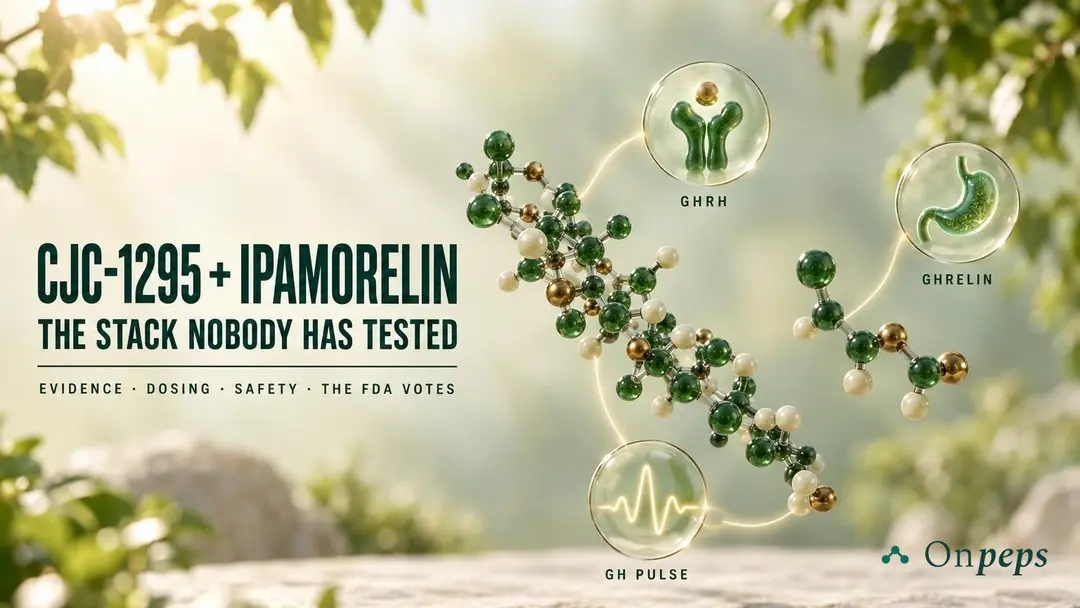
Most peptide regulatory stories are about a compound the FDA has never looked at. This one is about two it looked at closely.
2023: Category 2
On September 29, 2023, the FDA moved CJC-1295, ipamorelin acetate, and more than a dozen other peptides into Category 2 of its interim 503A compounding policy, the list of substances it says raise significant safety concerns. For ipamorelin it cited immunogenicity, unnatural amino acids, “serious adverse events including death when ipamorelin was administered intravenously for improving gastric motility,” and no safety information at all for the subcutaneous route anyone actually uses. For CJC-1295 it cited immunogenicity, impurities, and “serious adverse events associated with CJC-1295 including increased heart rate and systemic vasodilatory reaction.”
2024: the lawsuit and the two votes
Evexias Medical Centers and Farmakeio, a Texas clinic network and compounding pharmacy, sued the FDA over the lack of process behind those placements. The suit covered AOD-9604, CJC-1295, ipamorelin acetate, and thymosin alpha-1, and it settled in September 2024 with the FDA agreeing to put all four through its Pharmacy Compounding Advisory Committee (PCAC). The nominators withdrew their nominations along the way, which took the substances out of 503A Category 2, but the FDA reviewed both compounds anyway, “on its own initiative.”
On October 29, 2024, the committee took up ipamorelin. The FDA’s review found no safety data for the subcutaneous route, the two deaths in the ileus trial, a class concern about glucose, and an acetate form that was not well characterised. The committee voted 0 to 12, with one abstention, against placing ipamorelin free base on the list, and 0 to 12 with one abstention against ipamorelin acetate. The same meeting voted 0 to 11 against MK-677 and unanimously against kisspeptin-10.
On December 4, 2024, the committee took up CJC-1295 in five forms: free base, acetate, and three DAC salts. The FDA’s review found no studies of effectiveness in humans for any use, injection-site haemorrhage and necrosis in rats and dogs at every dose tested, the pituitary DNA-damage finding, and a marketplace in which at least five substances and nine names circulated under one product name. Evexias, Farmakeio, and their counsel spoke in the open hearing. The committee voted 0 to 13 against the free base and each DAC form, and 1 to 12 against the acetate. The one recorded comment was on the lack of evidence for effectiveness.
2026: the thaw that skipped them
On April 15, 2026, Secretary Kennedy confirmed twelve peptides had been removed from Category 2, among them BPC-157, TB-500, MOTS-c, injectable GHK-Cu, Semax, KPV, and Epitalon. Seven went before PCAC on July 23 and 24, 2026, and six were recommended for the compounding list; our July 2026 FDA update covers that meeting. The remaining five are scheduled for a meeting before the end of February 2027.
CJC-1295 and ipamorelin are on neither list. They were not removed in April because they had already been through the committee and lost, and they are on neither the July nor the February 2027 agenda. The FDA’s current 503A category document, updated May 14, 2026, lists neither compound in any category. On the 503B side, for outsourcing facilities, ipamorelin acetate remains in Category 2.
What that means in practice
A US pharmacy may compound a substance only if it is the ingredient of an approved drug, has a USP monograph, or is on the 503A bulks list. Neither compound qualifies, and the advisory committee has recommended against adding either. No pharmacy in the United States has a lawful basis to compound CJC-1295 or ipamorelin, and a telehealth prescription does not create one. The Ohio Board of Pharmacy has named CJC/ipamorelin in its guidance and summarily suspended pharmacies for compounding it. A research-use-only vial is an unapproved drug sold under a disclaimer the FDA has said does not survive marketing copy aimed at human use.
In sport, WADA’s Prohibited List names ipamorelin among growth hormone secretagogues and CJC-1295 among GHRH analogues, both under S2, prohibited at all times, and both are detectable in urine.
This stack is not in a gray area
Each half has been individually put before the FDA’s expert committee and rejected without a vote in favour, and the 2026 reversal that freed a dozen other peptides did not include either of them.
Conclusion
Understanding this regulatory reality is the prerequisite for rational use.